An AI SDR (artificial intelligence sales development representative) is software that uses machine learning and natural language processing to automate top-of-funnel sales tasks such as prospecting, lead qualification, outreach, and meeting scheduling. AI SDRs analyze CRM data, intent signals, and firmographic information to identify and engage potential buyers through email, LinkedIn, and chat. Most tools cost between $750 and $3,500 per month, compared to $110,000-$138,000 annually for a fully loaded human SDR. They work best for high-volume lead engagement and inbound qualification, allowing sales teams to scale pipeline generation without proportional headcount growth.
The average SDR tenure is 14-18 months (Bridge Group benchmarks roughly 18 months, with only about 15 of those productive). Annual turnover runs around 35%. Vendor blogs claim 80%+ miss quota, but independent data from Bridge Group shows roughly 68% of SDRs actually hit their targets -- still not great, but a different story than the doomsday pitch. And every time one leaves, you're looking at $100,000-$115,000 in recruiting, onboarding, and ramp costs, only to restart the cycle.
That math is why AI SDRs have gone from a novelty to a genuine line item in sales budgets. The AI SDR market hit an estimated $4.1 billion in 2025 and is projected to reach roughly $15 billion by 2030 (around 30% CAGR). Gartner predicts that by 2028, roughly 60% of B2B sales rep work will be executed via conversational AI. These tools promise to handle the repetitive top-of-funnel work that burns out human reps: prospecting, cold outreach, follow-ups, lead qualification, and meeting booking.
But here's the thing -- every article you'll find about AI SDRs is written by a company selling one. Salesforce is pitching Agentforce. Artisan is pitching Ava. AiSDR is pitching, well, AiSDR.
I don't sell an AI SDR. I evaluate tools across the sales and marketing stack (here's my recent Gojiberry AI review as an example). This article explains what AI SDRs actually are, how they work under the hood, and where the hype gets ahead of reality.
What Is an AI SDR?
An AI SDR is software that uses artificial intelligence to perform the tasks traditionally handled by a human sales development representative. That includes prospecting for new leads, sending personalized outreach, qualifying inbound inquiries, following up with prospects who go quiet, and booking meetings for account executives.
The "AI" part matters. Basic sales automation tools follow static sequences: send email A on day 1, email B on day 3, email C on day 7. An AI SDR uses natural language processing (NLP) to understand and generate human-sounding messages, and machine learning to improve its targeting and messaging over time based on what gets responses.
You'll also see these tools called "AI sales agents," "virtual SDRs," or "AI BDRs" (business development representatives). The terminology is inconsistent across the industry, but they all describe the same core concept: software that automates the early stages of the sales pipeline.
The key difference between an AI SDR and a human SDR comes down to strengths and weaknesses. An AI SDR can work 24/7 across every time zone, handle hundreds of conversations simultaneously, and never forget a follow-up. A human SDR can read emotional cues, build genuine rapport, navigate unscripted conversations, and handle the nuanced objections that come with complex enterprise deals.
Neither is a complete replacement for the other. The teams getting the best results are running both.
How AI SDRs Work
Behind the marketing language and branded personas (Artisan's "Ava," 11x's "Alice," Alta's "Katie"), AI SDRs follow a fairly consistent technical pipeline. Here's what actually happens:
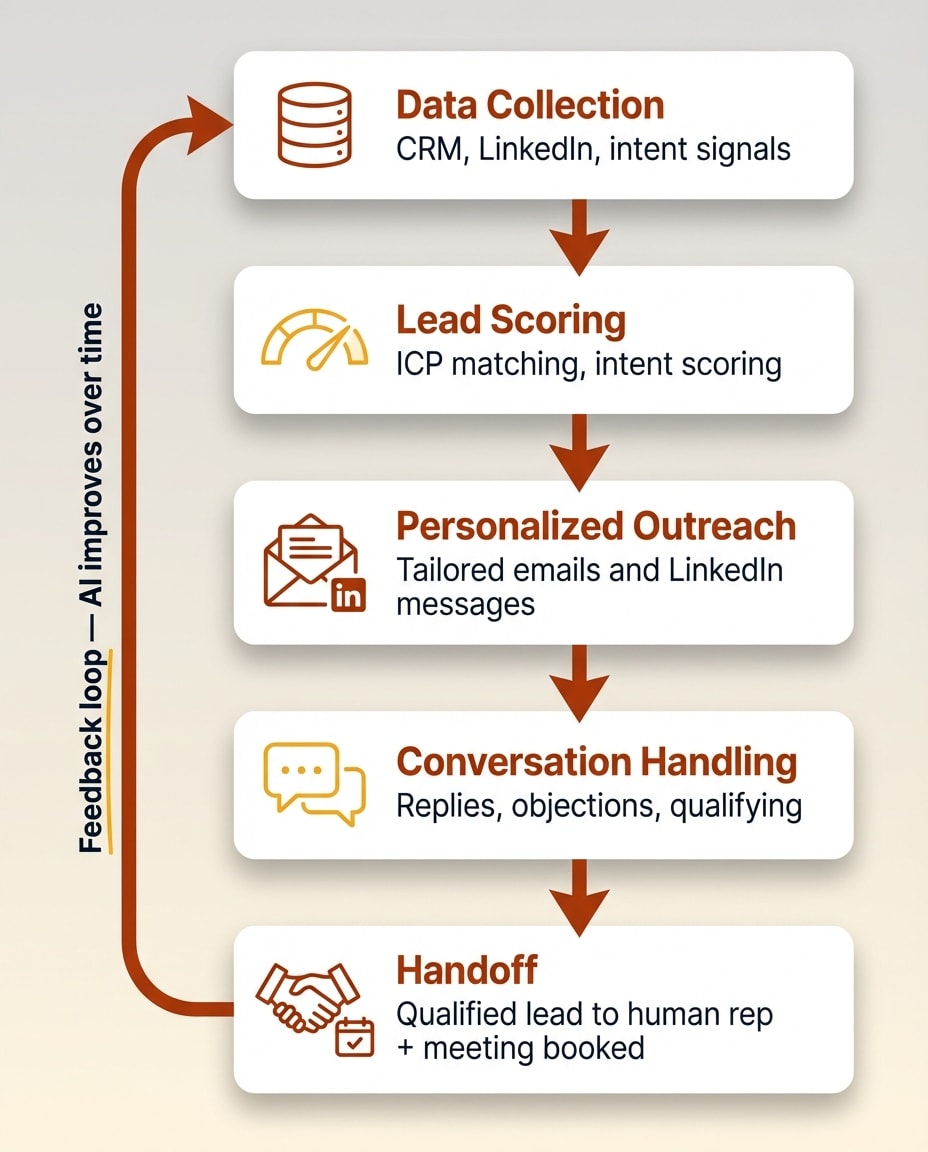
Step 1: Data Collection and Enrichment
The AI SDR pulls information from your CRM, connected data sources, and third-party providers. This includes firmographic data (company size, industry, revenue, tech stack), behavioral signals (website visits, content downloads, email opens), and intent data (job changes, funding rounds, competitor engagement).
Some tools scrape data from hundreds of millions of contacts across partner databases. Others focus specifically on LinkedIn intent signals: who's engaging with competitor content, who just changed roles, who just received funding.
Step 2: Lead Scoring and ICP Matching
The AI scores each lead against your ideal customer profile (ICP). This uses machine learning models that evaluate fit (does this person match your target buyer?) and intent (are they showing buying signals?). High-scoring leads get prioritized for outreach.
Step 3: Personalized Outreach
Using the enriched lead data, the AI generates tailored messages. This is where NLP does the heavy lifting, writing emails that reference the prospect's company, recent activity, pain points, or role-specific challenges. The best AI SDRs go beyond mail merge. They construct messages that read like a human wrote them, pulling from proven sales frameworks and adapting tone based on the prospect's profile.
Step 4: Conversation Handling
When a prospect replies, the AI SDR doesn't just stop. It continues the conversation, answering basic questions, handling standard objections, and asking qualifying questions (budget, timeline, authority, need). This is where the technology varies most between tools. Some handle multi-turn conversations well. Others struggle with anything off-script.
Step 5: Handoff to Humans
When the AI identifies a qualified opportunity, it routes the lead to a human rep with full context: conversation history, qualification notes, and a booked meeting on the rep's calendar. The human picks up where the AI left off.
The Feedback Loop
The AI continuously learns. It tracks which subject lines get opens, which messages get replies, which qualification questions correlate with closed deals, and adjusts its approach. This works, but it requires enough data volume to be meaningful. A campaign with 50 emails won't generate useful learning. A campaign with 5,000 will.
What AI SDRs Can and Can't Do
Vendor marketing tends to blur this line, so let me be direct.
Want to Hear From Me Weekly?
I'm putting together a weekly email with the real stuff. What's working, what's not, and the tools I'm actually using to grow. Not live yet, but you can grab a spot. Totally free!
What they handle well:
- High-volume outreach. An AI SDR can manage thousands of personalized sequences simultaneously. Bridge Group reports the average human SDR manages roughly 45 calls and emails per day, yielding about 5 quality conversations. AI removes that ceiling entirely.
- Instant lead response. AI SDRs respond in seconds or minutes. The average human SDR response time is 42-47 hours, and 73% of inbound leads never get a first reply at all.
- Consistent follow-up. No dropped balls, no forgotten sequences, no "I meant to follow up but got busy."
- 24/7 coverage. Over 75% of inbound inquiries happen outside business hours. AI covers the gap.
- CRM hygiene. Every interaction logged automatically with notes and context. No more begging reps to update Salesforce.
Where they fall short:
- Complex objections. When a prospect raises a nuanced concern about integration with their specific tech stack, AI stumbles.
- Emotional intelligence. AI cannot read hesitation, excitement, frustration, or humor the way a human can. It misses the signals between the lines.
- Unscripted conversations. If the conversation goes somewhere the AI wasn't trained for, quality degrades fast.
- Enterprise deals. Multi-stakeholder, long-cycle B2B deals need human relationship-building. AI SDRs are top-of-funnel tools, not deal closers.
- Spam and deliverability. Roughly 30% of fully AI-written emails land in spam folders, compared to under 5% for humanized content. High-volume AI outreach without careful domain warming and content variation can torch your sender reputation fast.
- Cold outbound. Even Salesforce acknowledges that fully autonomous outbound is more complex for AI SDRs. Inbound qualification is where they shine. Cold outbound results are much less consistent.
Types of AI SDR Tools
Not all AI SDR tools work the same way. Here's how the market actually breaks down:
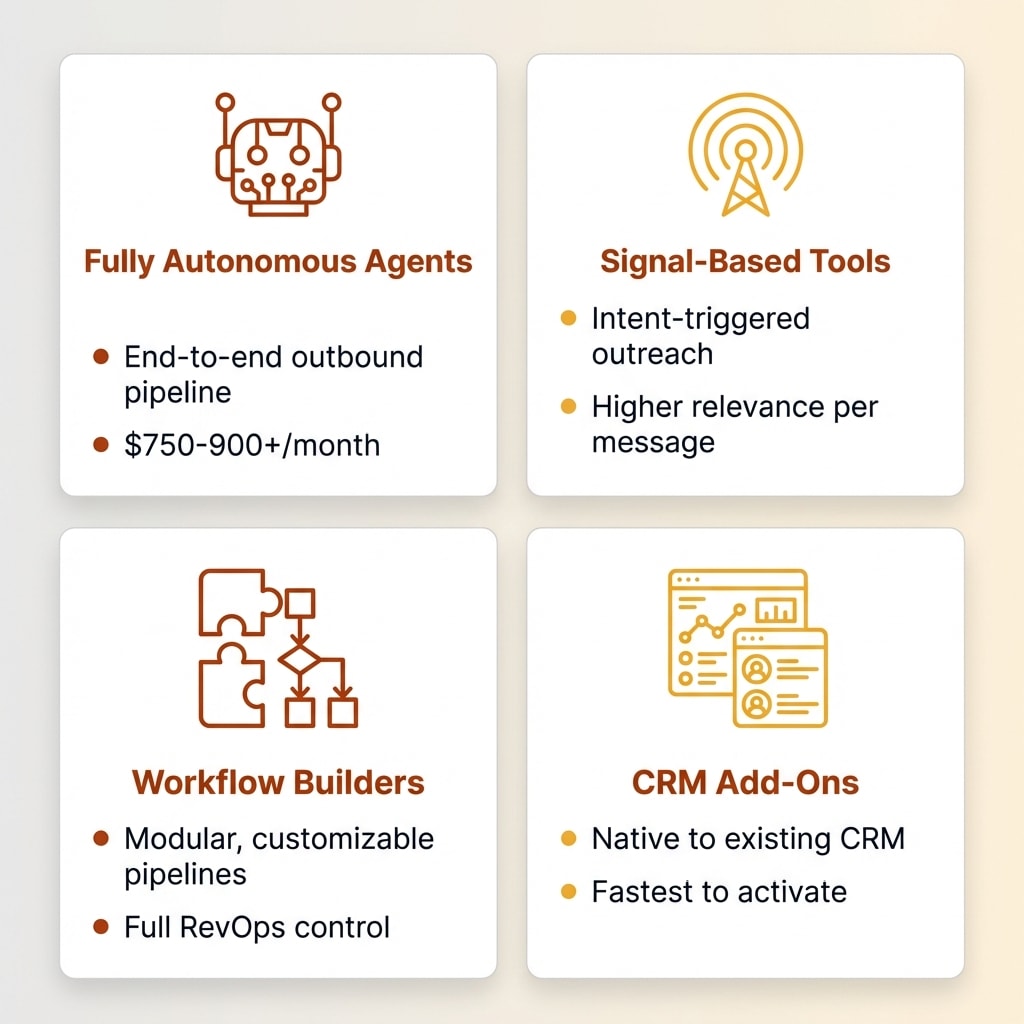
Fully Autonomous Agents
Tools like 11x (Alice), Artisan (Ava), and AiSDR handle the entire outbound pipeline: prospecting, email sequences, follow-ups, and conversation handling. You define your ICP and messaging preferences, and the AI runs your outbound operation.
Pricing: $750-$3,000+/month. AiSDR charges about $900/month for 1,200 messages, bringing the cost per email under $1. Artisan runs roughly $2,000-$3,000/month for about 1,000 leads. 11x sits at the higher end, around $50,000-$60,000/year.
Best for: Teams that want to replace or supplement SDR headcount for outbound email campaigns.
Trade-off: You're trusting the AI with your brand voice and prospect relationships. Quality varies. Some users report issues with emails generated in the wrong language, or metrics that count "unsubscribe me" as a positive reply.
Signal-Based Outreach Tools
These tools monitor buying signals -- LinkedIn engagement, job changes, funding events, competitor interactions -- and trigger personalized outreach when intent is detected. Our guide to automating LinkedIn outreach covers how this works in practice and what to watch for.
Gojiberry AI is a good example. Rather than blasting a list, it identifies who to contact based on real-time signals, then initiates outreach.
Best for: Targeted outbound where timing matters more than volume. The reply rate benchmarks tell the story: generic cold emails pull 1-3%, basic personalization (first name, company) gets 5-9%, and signal-based outreach, triggered by a real buying event, can hit 15-40%.
Trade-off: Smaller reach, but higher relevance per message.
Workflow Builders
Tools like Clay and Default let you assemble custom SDR workflows from modular components: enrichment providers, scoring models, routing rules, and scheduling integrations. You build the pipeline; the tool automates it.
Best for: RevOps teams that want granular control over every step of the process.
Trade-off: More setup and maintenance required. You need to know what you're building.
CRM Platform Add-Ons
Salesforce (Einstein SDR / Agentforce), monday CRM, and HubSpot (Breeze) all offer native AI SDR features within their platforms. These activate inside your existing CRM and use your existing data.
Pricing: Varies widely. monday CRM includes its AI SDR agent in higher tiers. Salesforce Agentforce is enterprise-level pricing. Qualified's Piper starts above $3,500/month.
Best for: Teams already invested in a CRM ecosystem who want AI capabilities without switching tools.
Trade-off: You're locked into that vendor's AI capabilities, which may be less specialized than dedicated AI SDR tools.
Who Should Consider an AI SDR
Good fit:
- B2B companies with high inbound volume. If leads are sitting in a queue for hours or days, an AI SDR can respond in seconds and qualify before a human touches them.
- Small sales teams that need to scale. A 3-person team that can't afford to hire 2 more SDRs can use AI to cover the volume gap.
- Companies with a clear ICP. AI SDRs need well-defined criteria to score and qualify leads effectively. Vague targeting produces vague results.
- Teams with clean CRM data. AI SDRs are only as good as the data they work with. Bad data means bad outreach.
Not the best fit:
- Enterprise sales with complex cycles. If your average deal involves 6 stakeholders and 9 months of relationship-building, an AI SDR handles the first touch only.
- Companies without defined processes. If you don't know your ICP or haven't documented your qualification criteria, automating a broken process just breaks it faster.
- Industries requiring a personal touch from first contact. Certain verticals (high-end consulting, wealth management) expect human interaction from the start.
- Teams with bad CRM data. Garbage in, garbage out. Fix your data before adding AI on top.
Something New Is Coming...
A weekly breakdown of what's working across SaaS, ecommerce, and online marketing. The kind of stuff I'd tell a friend. Not launched yet, but you can grab a spot. Totally free!
The Hype vs Reality of AI SDRs
Every vendor page for AI SDRs reads like the future of sales has already arrived. Some of it is real. Some of it is marketing.
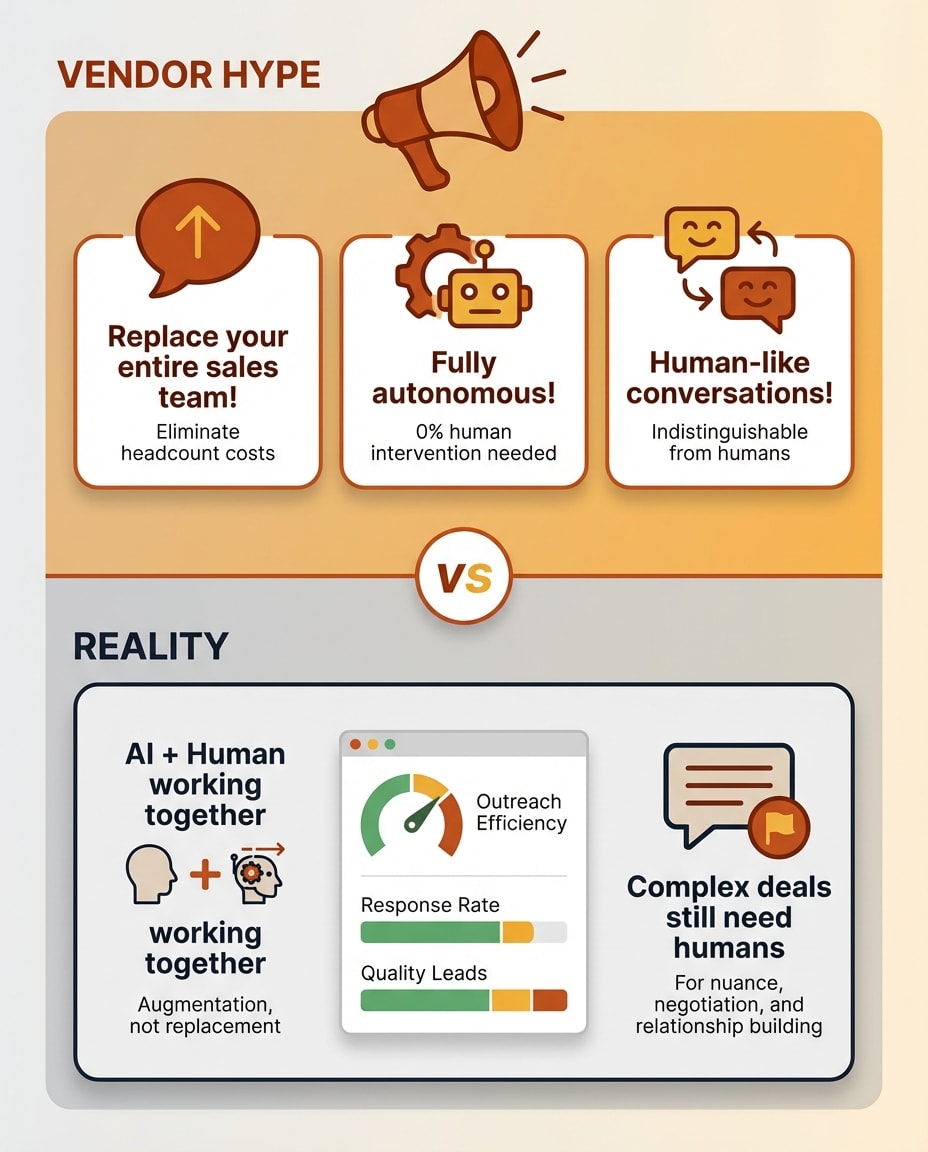
What vendors oversell:
"Replace your SDR team." In practice, AI SDRs augment human teams. They handle volume and routine. Humans handle relationships and complexity. The companies reporting the highest ROI from AI SDRs are using hybrid setups, not full replacement.
"Fully autonomous outbound." Inbound lead qualification is where AI SDRs deliver the most consistent results. Cold outbound -- where the prospect has no prior relationship with your brand -- produces much more variable outcomes. Prospeo found that targeted manual outreach still pulls 3-8% reply rates compared to 2-5% for typical AI campaigns. AI wins on volume and cost per message, not conversion rate. The technology is improving, but it's not the slam dunk that vendor marketing suggests.
"Human-like conversations." The technology is better than chatbots from five years ago, but prospects can often tell they're talking to AI. There's a personalization paradox at play: the more polished and perfectly tailored an AI message looks, the more prospects suspect it came from a bot. Testing shows that AI SDRs work well within their training boundaries and degrade when conversations go off-script.
Inflated metrics. Some tools count negative replies ("remove me from your list") in their response rate calculations. Always ask how a vendor defines their success metrics before comparing numbers.
Where AI SDRs genuinely deliver:
Speed-to-lead. This is the single strongest case for AI SDRs. Research consistently shows that responding within 5 minutes dramatically increases conversion. Companies are 21x more likely to convert a lead when they respond that fast. Most human SDR teams can't hit that consistently. AI can.
Consistency. AI SDRs don't cherry-pick the best leads and ignore the rest. They don't have bad days. They don't forget follow-ups. Every lead gets the same treatment.
Cost efficiency at the top of funnel. For $750-$900/month, an AI SDR can send 1,000+ personalized messages, work that would cost $9,000+/month in fully loaded human SDR cost. One important caveat: measure downstream conversion (opportunity-to-close rate), not just meetings booked. AI-booked meetings may convert at lower rates than human-sourced ones, so cost-per-closed-deal is the number that actually matters.
Freeing up human reps. The best outcome isn't replacing humans. It's letting them focus on what only humans can do: build relationships, run demos, negotiate, and close deals.
Frequently Asked Questions
What does AI SDR stand for?
AI SDR stands for artificial intelligence sales development representative. It refers to software that uses machine learning and NLP to automate prospecting, outreach, lead qualification, and meeting booking, tasks traditionally performed by human sales reps.
How much does an AI SDR cost?
Most AI SDR tools cost between $750 and $3,500+ per month. AiSDR charges approximately $900/month for 1,200 messages. Signal-based tools like Gojiberry AI start at $99/month. CRM-native solutions like Salesforce Agentforce and Qualified's Piper are priced at enterprise levels, often starting above $3,500/month. Compare this to a human SDR's fully loaded annual cost of $110,000-$138,000+ including salary, benefits, training, equipment, and management overhead.
Can an AI SDR replace a human SDR?
Not fully. AI SDRs handle high-volume, repetitive top-of-funnel tasks well: outreach, follow-up, initial qualification, and meeting booking. But they lack the emotional intelligence, creativity, and relationship-building skills needed for complex deals. The strongest results come from hybrid teams where AI handles volume and humans handle depth.
What is the difference between an AI SDR and a chatbot?
A chatbot follows pre-set rules and decision trees. An AI SDR uses machine learning and natural language processing to understand context, generate personalized messages, adapt its approach based on results, and hold multi-turn conversations. AI SDRs are goal-oriented (qualify leads, book meetings) rather than simply reactive.
Do AI SDRs work for outbound sales?
They can, but with caveats. AI SDRs perform best with inbound qualification where the lead has already shown interest. For cold outbound, results are less predictable. Fully autonomous outbound agents can run email campaigns, but response rates depend heavily on list quality, ICP definition, and message relevance. Signal-based tools that trigger outreach based on buying intent tend to produce better outbound results than pure cold-blast approaches.
Bottom Line
AI SDRs are real tools solving a real problem: the top of the sales funnel is expensive, repetitive, and hard to scale with humans alone.
But they're not magic. The best results come from treating an AI SDR as a team member, not a replacement for your team. Start with a specific use case (inbound lead qualification, follow-up automation, or signal-based outreach) and expand from there.
The tools that work are the ones that make your existing team faster. Not the ones promising to replace them entirely.