Gojiberry AI is an AI-powered LinkedIn outreach platform that uses automated agents to detect buyer intent signals and generate warm leads for B2B sales teams. Priced at $99 per month for the Pro plan, it monitors over 30 signals including competitor engagement, job changes, and funding events to identify prospects actively entering a buying cycle. The platform then initiates personalized LinkedIn campaigns with reported reply rates reaching 31 percent. It is best suited for founders and small sales teams that prioritize quality leads over volume-based outreach.
I went looking for an honest Gojiberry AI review and couldn't find one. The top results are a competitor pitching their own tool, AI-generated filler articles, and Gojiberry's own marketing content. Not exactly helpful when you're trying to decide if something is worth $99 a month.
So here's what I put together after signing up, running campaigns, and using the platform myself. A straight breakdown of what Gojiberry AI does, what it costs, where it shines, and where it falls short.
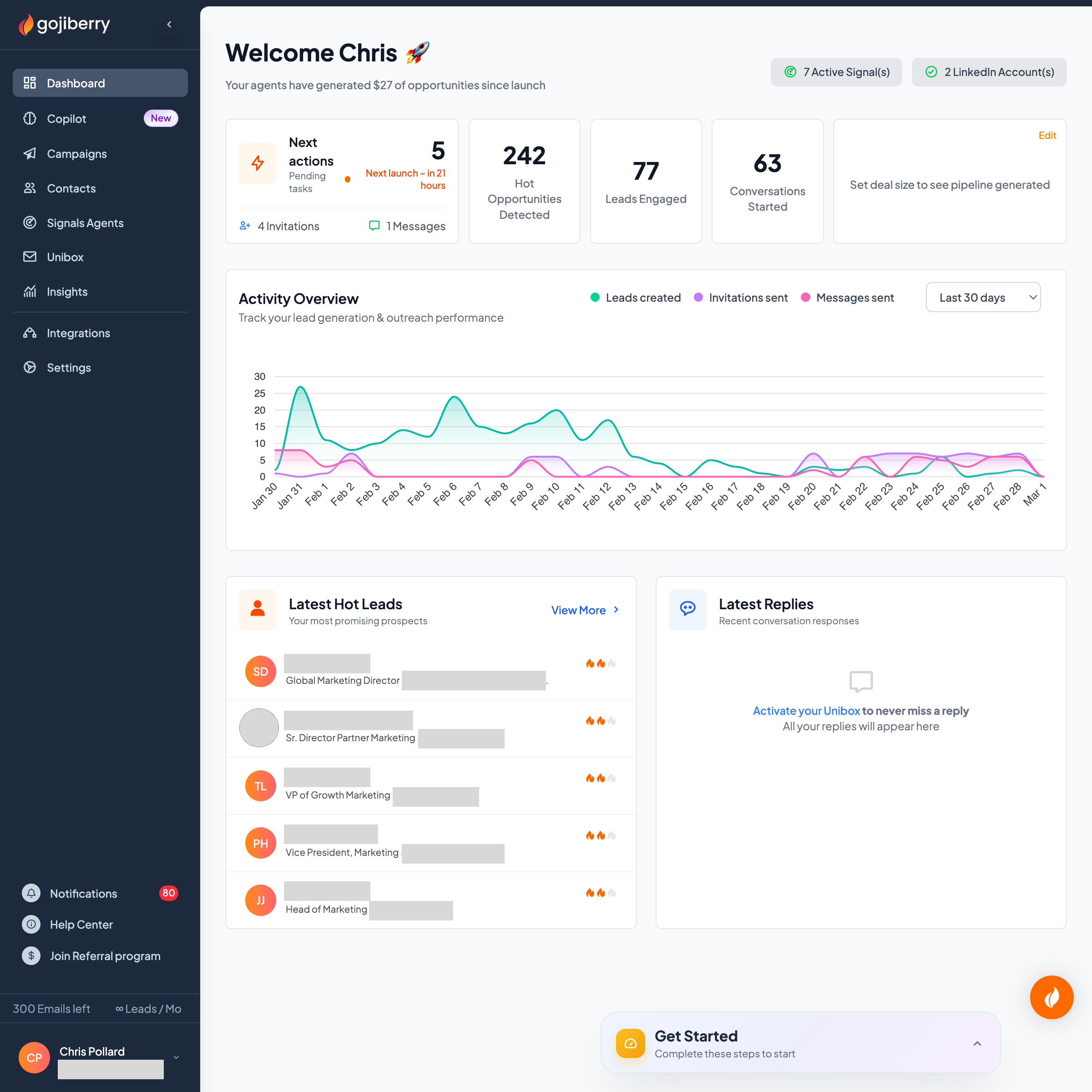
The dashboard above is what you see after setup. In my case, Gojiberry's agents detected 242 hot opportunities, engaged 77 leads, and started 63 conversations, all running in the background while I focused on other work. The activity chart tracks leads created, invitations sent, and messages sent over time, so you can see outreach momentum at a glance.
What Is Gojiberry AI?
Gojiberry AI is an AI sales agent platform that monitors LinkedIn and the web for buyer intent signals, then uses those signals to generate and engage warm leads on autopilot. Think of it as a 24/7 SDR that watches for people showing buying behavior and reaches out before your competitors do.
Before we go further, there's a brand confusion issue worth addressing. When you search "Gojiberry," you'll find two completely different products. Gojiberry AI is the B2B sales tool covered in this review. There's also a Gojiberry survey app on the Shopify App Store, which is an entirely separate product for ecommerce post-purchase surveys. Different companies, different products.
Gojiberry AI was founded in 2025 and is based in France. It sits in the AI SDR category alongside tools like Apollo.io, Clay, 11x.ai, and Salesforge. Where it differs is its approach: most competitors start with a database of contacts and let you filter. Gojiberry starts with signals, it finds people who are actively showing buying behavior right now, then brings them to you.
The company is still early stage. That matters for anyone evaluating the tool, and I'll address it in the pros and cons section.
One thing worth mentioning: the founders are very active on X and have been building in public. They've grown to a pretty significant run rate in a short time, and what's fascinating is they're clearly dogfooding their own product to do it. They're using Gojiberry to build their own hype and pipeline, which is honestly the best endorsement you can get. Their marketing strategies are genuinely smart and worth following even if you never subscribe to the tool.
That said, there's been some pushback on Reddit because they've been hitting the platform hard with content. I get why that rubs people the wrong way. My take: they're testing every channel and doubling down on what works. That's hustle, not spam. Early-stage founders who aren't aggressively testing channels are the ones I'd worry about.
How Gojiberry AI Works
The platform is built around five core functions that work as a pipeline: detect, filter, review, engage, analyze.
Intent Signal Detection
This is Gojiberry's core differentiator. AI agents run 24/7, monitoring over 30 intent signals across LinkedIn and the broader web. These signals include:
- Competitor engagement, prospects liking, commenting on, or following your competitors' content
- Job changes, new hires in key decision-making roles (VP of Sales, Head of Growth, etc.)
- Funding events, companies that just raised capital are often in buying mode
- Content interaction, engaging with posts about topics related to your product
- Event attendance, RSVPs to industry events and conferences
- Group membership, joining LinkedIn groups relevant to your space
The idea is straightforward: someone showing these behaviors is more likely to be receptive to outreach than a cold contact pulled from a database.
ICP Filtering and Lead Scoring
Every detected lead is run through your Ideal Customer Profile settings. You define the job titles, company sizes, industries, and other criteria that matter. The AI scores each lead based on how many signals they've triggered and how closely they match your ICP.
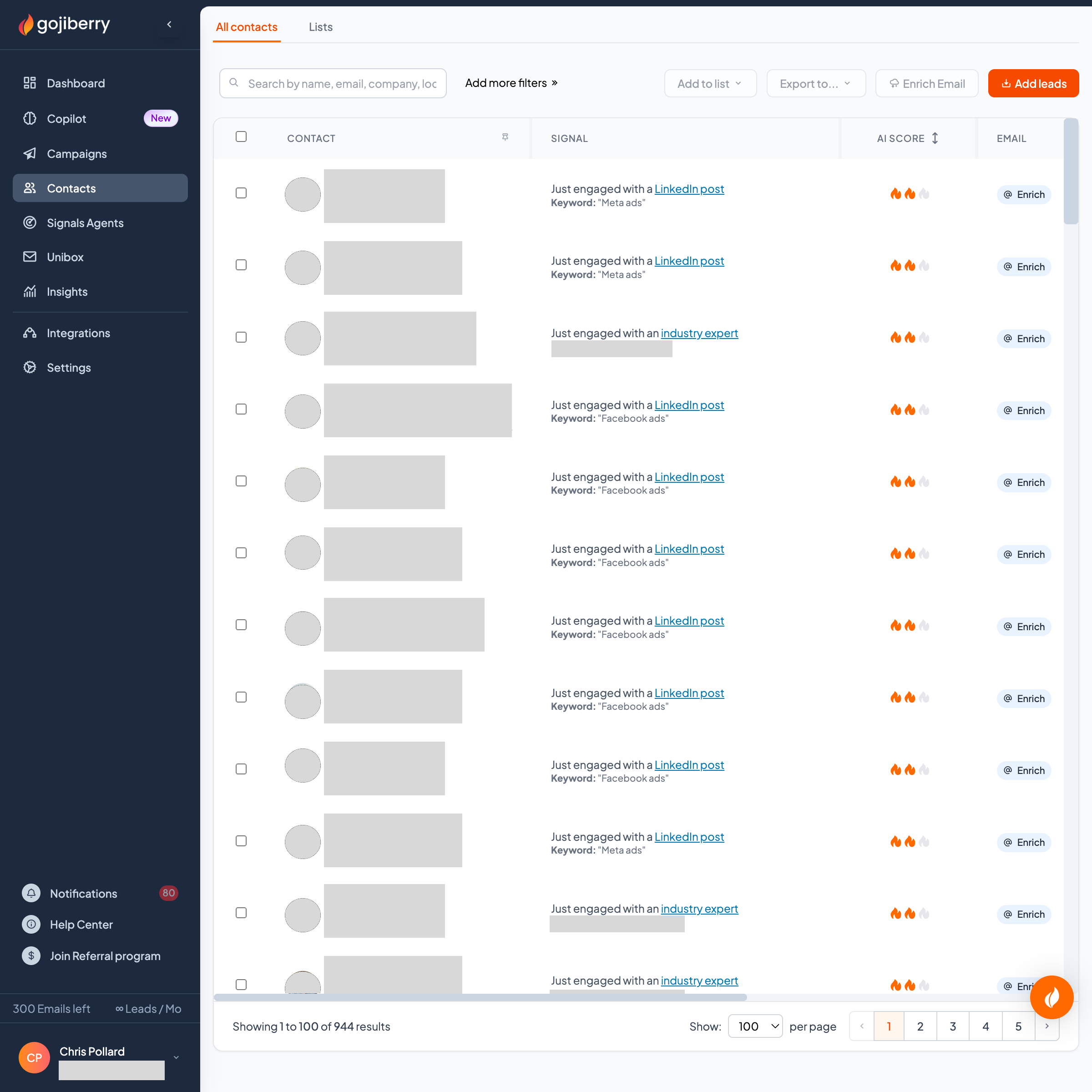
Here's what the contacts page looks like in practice. In my account, Gojiberry surfaced 944 leads, each showing the signal that triggered them (like engaging with a LinkedIn post or an industry article), an AI score represented by the flame icons, and enrichment status. You can filter, export, or push leads directly to your CRM from this view. The signal column is the most useful part: it tells you why someone was flagged, so you can reference it in your outreach.
This filtering step is what separates Gojiberry from a basic LinkedIn scraper. Instead of "here's 10,000 people who match your title filter," you get a shorter list of people who match your profile AND are actively showing buying behavior.
Goji Copilot: The Human Review Layer
This is a feature Gojiberry doesn't emphasize enough in their marketing. The Copilot is where you review and approve (or reject) AI-recommended leads before outreach fires.
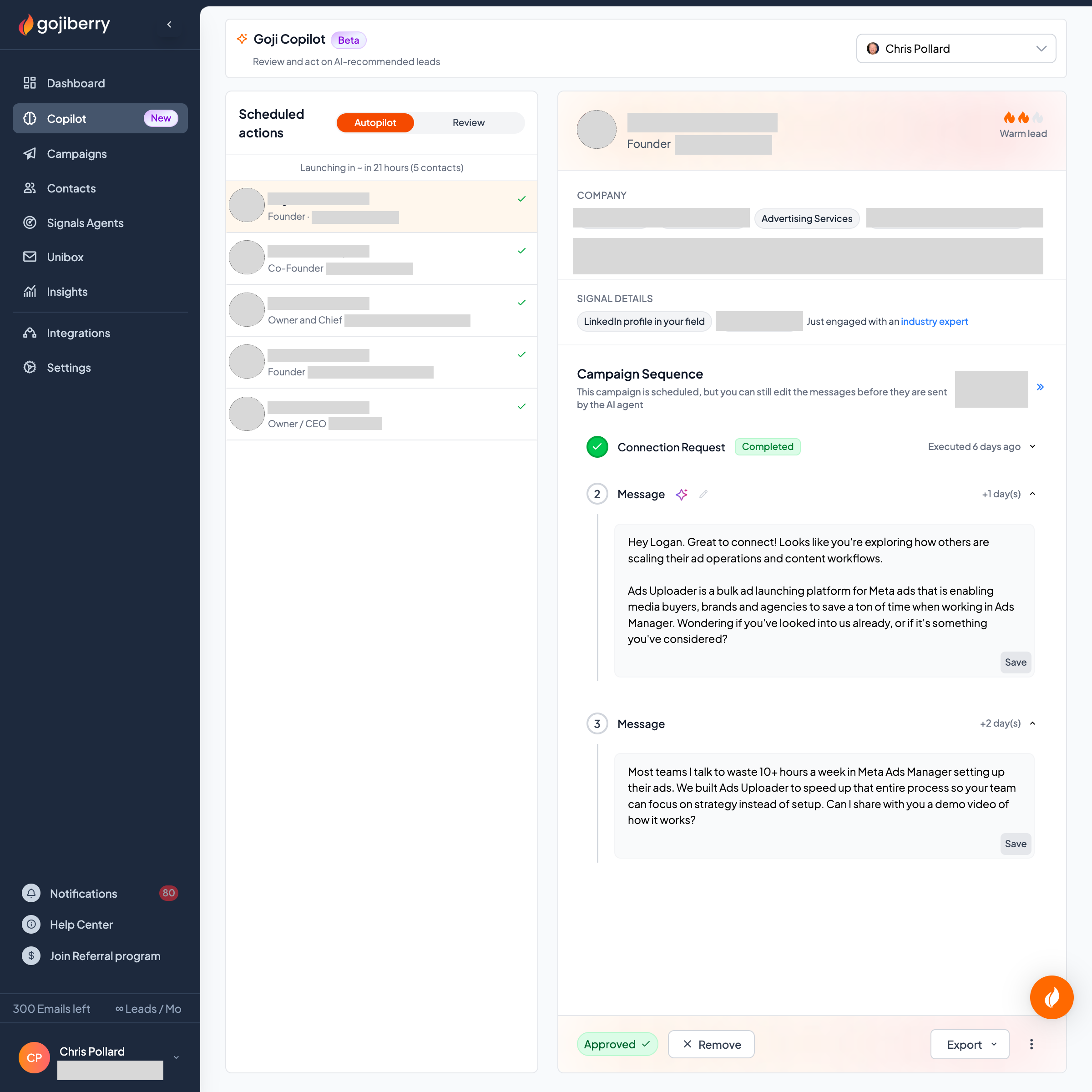
It works in two modes: Autopilot lets the AI run fully autonomous, while Review mode queues every lead for your approval first. In the screenshot, you can see a list of scheduled actions on the left, each showing the lead's name, title, and company. Click any lead and the right panel shows the actual LinkedIn post or activity that triggered the signal, what type of signal it was ("Just engaged with an industry expert"), and the full multi-step outreach sequence the AI drafted.
This is important because it means you're not blindly trusting the AI. You can see exactly why someone was flagged and what message they'll receive. In Review mode, you check off leads you approve and skip the rest. In Autopilot mode, the AI handles everything, useful once you trust the signal quality, but risky if your ICP isn't dialed in yet.
The message sequences themselves are multi-step. In the copilot view I could see Step 1 (connection request with note), Step 2 (+1 day follow-up), and Step 3 (+2 days later). Each step has its own message content that you can edit before approving.
Automated LinkedIn Outreach
Once a lead is qualified (or approved in Copilot), Gojiberry launches personalized LinkedIn messages through campaigns. The personalization is signal-based, meaning the outreach references the specific behavior that flagged the prospect.
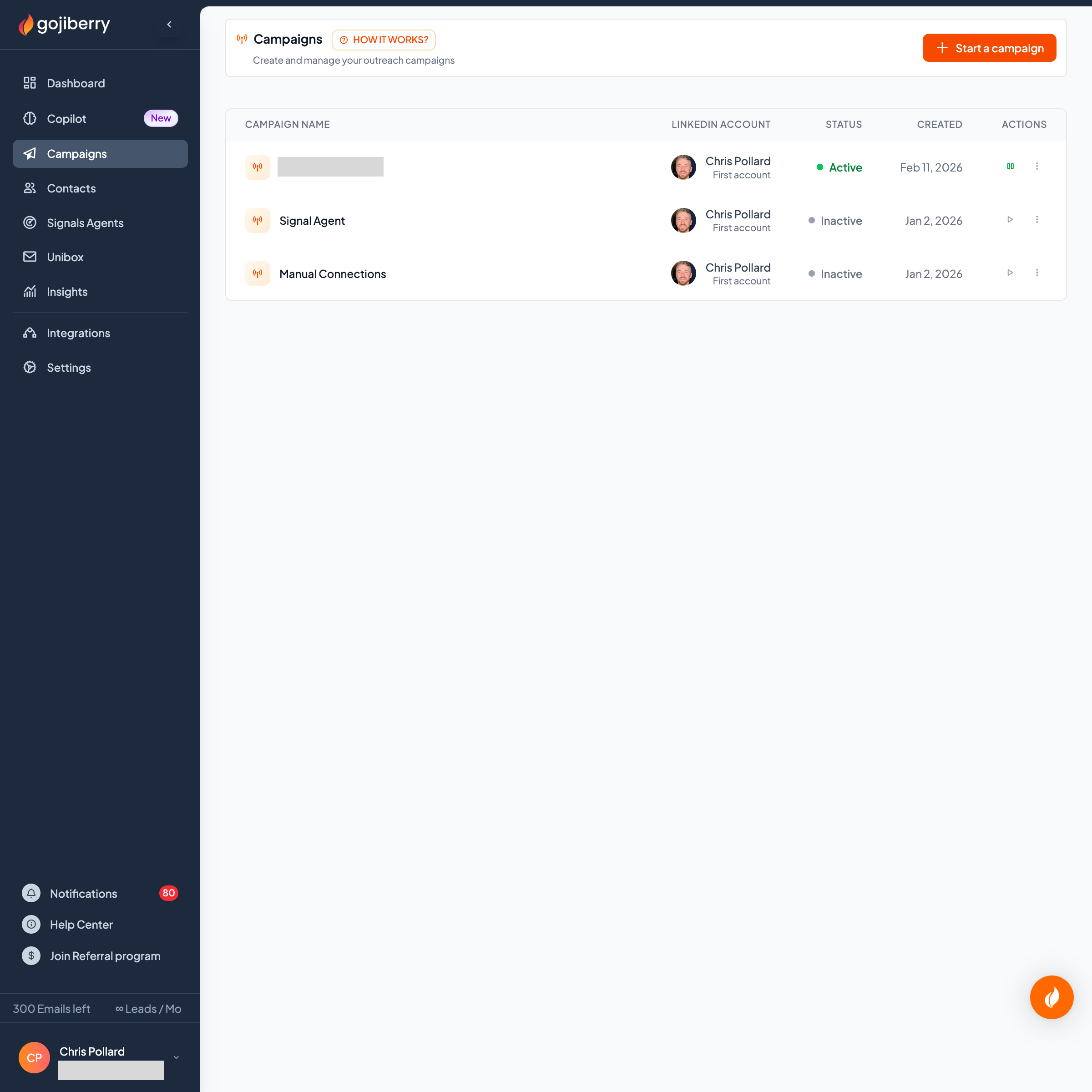
The campaigns view keeps things straightforward. You can run multiple campaigns simultaneously, each tied to a LinkedIn account with its own targeting criteria. Each campaign has tabs for Workflow (where you design automation steps visually), Contacts, Last Launches, campaign-level Insights, and Settings. The visual workflow builder lets you map out the outreach sequence as automation blocks rather than just a flat message list.
For example, instead of a generic "I'd love to connect" message, the AI might craft something like: "Saw you just moved into the VP of Sales role at [Company], teams in your position usually evaluate their tech stack in the first 90 days."
The platform claims campaign reply rates of 18-31%, compared to the 1-2% typical of cold email.
Signal Performance Analytics
Most intent tools leave you guessing about which signals actually drive results. Gojiberry's Insights page breaks this down.
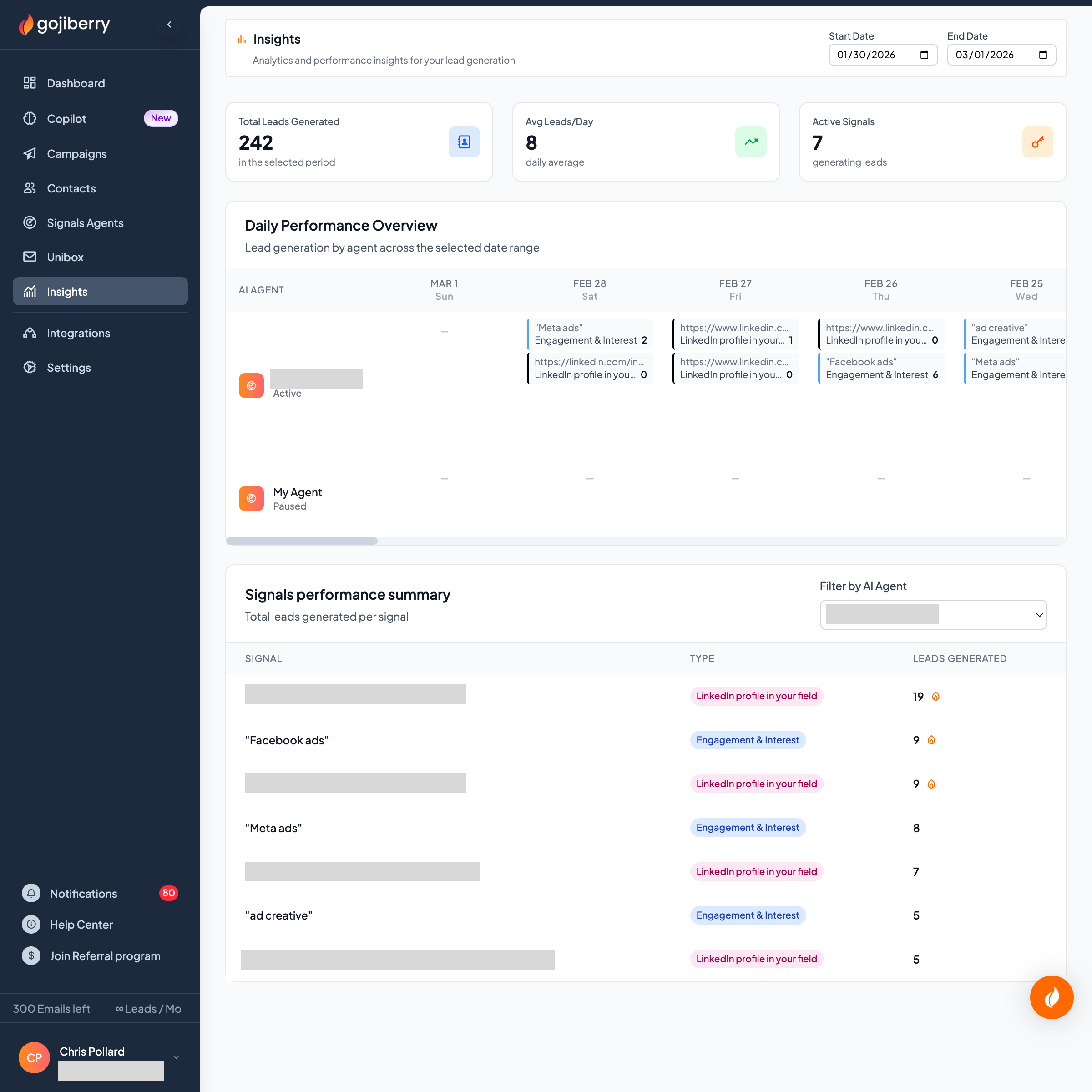
The analytics dashboard shows total leads generated, average leads per day, and currently active agents. The most useful section is the Signals performance summary at the bottom. It ranks which signal types generate the most leads. In my account, "LinkedIn profile in your field" signals generated 19 leads, while "Engagement & Interest" signals around specific keywords (like "Facebook ads" and "Meta ads") generated 5-9 leads each. You can filter by AI agent to see which campaigns drive the most pipeline.
This data lets you double down on what's working. If competitor engagement signals are outperforming job change signals, you can adjust your agent configuration accordingly.
Want to Hear From Me Weekly?
I'm putting together a weekly email with the real stuff. What's working, what's not, and the tools I'm actually using to grow. Not live yet, but you can grab a spot. Totally free!
Integrations and CRM Sync
The integrations page is more extensive than Gojiberry's marketing suggests.
There are 15 integrations across three categories: CRM (HubSpot, Pipedrive, Folk CRM, Zoho, SmartLead, Breakold CRM), Outreach Tools (Lemlist, SmartReach, HeyReach, plus one more), and Automation (Slack, Clay, webhooks, and a Zapier-like connector for 5,000+ apps). The Clay and webhook integrations are particularly useful for teams that already have complex prospecting workflows, and you can push Gojiberry's intent-qualified leads directly into your existing Clay tables or trigger custom automations.
The Slack integration remains the standout for speed. Set up a dedicated channel and get real-time alerts when high-intent prospects are identified. Speed matters with intent signals. A prospect who just engaged with your competitor's content today is more valuable than the same one contacted next week.
Gojiberry also has a Unibox, a unified inbox for managing all your LinkedIn conversations directly within the platform. It requires connecting your LinkedIn inbox separately (it's not automatic, which is a privacy-conscious design choice), but once activated, you can reply to prospects without switching back to LinkedIn.
Gojiberry AI Pricing Breakdown
Gojiberry keeps pricing simple compared to most tools in this space.
Pro Plan, $99/month per user
- 30+ intent signals
- 2 LinkedIn senders
- Unlimited LinkedIn campaigns
- Unlimited warm leads
- AI-powered outreach with lead scoring
- Email waterfall enrichment (15+ data providers)
- CRM and API integrations (HubSpot, Pipedrive, Slack)
- Chat and email support
Custom Plan, Contact sales
- For teams of 5+
- More LinkedIn accounts and signal capacity
- Dedicated Customer Success Manager
- Custom integrations
Trial: 7 days for $1 on the Pro plan.
At $99/month, Gojiberry is positioned below Clay ($149+/month) and well below enterprise tools like 11x.ai or 6sense. It's in a similar range to Apollo.io's mid-tier plans ($49-99), though the two tools solve different problems.
The value proposition comes down to whether intent-based leads are worth more to you than high-volume contact data. If you're a solo founder or small team where every conversation needs to count, $99 for warm, signal-driven leads is competitive.
There's also a cost angle that doesn't get talked about enough: LinkedIn outreach is significantly cheaper to run than cold email when you factor in the full infrastructure. I'm not discounting email outreach, it still works, but the inboxing problems have gotten worse. You need multiple domains, dedicated warm-up time, and email accounts that can go sour without warning. That infrastructure adds up fast, even when the tools themselves look cheap on paper. With LinkedIn, none of that applies. Everything is wrapped into one price, one platform, no deliverability headaches.
The ideal strategy is obviously both channels running simultaneously, and Gojiberry themselves have had great success doing exactly that. They have email waterfall enrichment built into the platform (15+ data providers), so you can collect verified emails through Gojiberry and export them to your email outreach tool of choice. Run LinkedIn intent-based outreach as your primary channel and layer email on top for prospects who don't respond on LinkedIn. That's the play.
Gojiberry AI vs Competitors
Here's how Gojiberry stacks up against the tools it's most often compared to.
| Feature | Gojiberry AI | Apollo.io | Clay | 11x.ai |
|---|---|---|---|---|
| Core approach | Intent signals first | Contact database first | Workflow builder + enrichment | Autonomous AI SDR agent |
| Price | $99/mo | $49-99/mo | $149+/mo | Enterprise (custom) |
| LinkedIn focus | Primary channel | One of many | One of many | Multi-channel |
| Intent signals | 30+ native | Limited | Via integrations | Built-in |
| Email outreach | Via enrichment only | Built-in | Via integrations | Built-in |
| Human review | Copilot with approve/reject | Manual list curation | Workflow-based | Limited |
| Integrations | 15 (CRM, outreach, automation) | 200+ | 100+ enrichment sources | Enterprise custom |
| Best for | Solo/small B2B teams | Data-heavy prospecting | Custom workflows | Enterprise automation |
| Setup complexity | Low | Medium | High | High |
Gojiberry AI vs Apollo.io
Apollo gives you a massive contact database (275M+ contacts) with email sequencing built in. It's broader, you get email, phone, LinkedIn, and more. Gojiberry is narrower but deeper on LinkedIn intent. If you need volume and multichannel outreach, Apollo wins. If you need quality LinkedIn leads based on real-time buying signals, Gojiberry has the edge.
Gojiberry AI vs Clay
Clay is a powerhouse for building custom prospecting workflows with 100+ data enrichment sources. It's more flexible but significantly more complex. Clay is for teams that want to build their own outreach machine. Gojiberry is for teams that want something working out of the box.
Gojiberry AI vs 11x.ai
11x offers autonomous AI SDR agents (Alice for outbound, Julian for inbound) that handle the full outreach cycle across channels. It's the enterprise play, more capability, more complexity, much higher price. Gojiberry is the lean alternative for founders and small teams who don't need (or can't afford) the full enterprise stack.
Who Should Use Gojiberry AI (And Who Shouldn't)
Good fit:
- B2B founders running their own outreach who need warm leads without spending hours prospecting
- Solo SDRs or small sales teams (2-5 people) who can't justify enterprise tools
- Agencies that need to show quick pipeline results for clients
- Anyone in a LinkedIn-heavy industry (SaaS, consulting, professional services)
Not a good fit:
- Enterprise teams needing multi-channel sequences (email, phone, LinkedIn, social)
- Companies in industries where LinkedIn isn't the primary sales channel (retail, local services)
- Teams that need massive contact databases rather than signal-based targeting
- Buyers who want a long-established vendor with years of track record
The LinkedIn dependency is the biggest factor. Gojiberry AI is fundamentally a LinkedIn-first tool. If your buyers aren't active on LinkedIn, the intent signals it tracks won't be useful. For B2B SaaS, consulting, and professional services, this is fine. For other verticals, it's a limitation.
Something New Is Coming...
A weekly breakdown of what's working across SaaS, ecommerce, and online marketing. The kind of stuff I'd tell a friend. Not launched yet, but you can grab a spot. Totally free!
Gojiberry AI Pros and Cons
Pros:
- Intent-first approach, focuses on who's showing buying behavior now, not just who matches a demographic filter
- Copilot review mode, lets you approve or reject every AI-recommended lead before outreach fires, so you're never blindly trusting the algorithm
- Signal performance analytics, the Insights page shows exactly which signals generate leads, so you can optimize over time
- Simple pricing, $99/mo with no confusing credit systems or usage caps
- Extensive integrations, 15 integrations including Clay, webhooks, and a Zapier-like connector for 5,000+ apps, not just basic CRM sync
- Unlimited campaigns, no artificial limits on outreach volume
- Low barrier to try, 7-day trial gives enough time to evaluate
Cons:
- LinkedIn-centric, no built-in email sequences, phone dialing, or multichannel outreach
- New company, founded 2025, limited track record and only 11 G2 reviews
- Autopilot mode requires trust, the fully autonomous mode works great once your ICP is dialed in, but can waste LinkedIn outreach capacity if signal quality isn't tuned yet
- Custom pricing isn't transparent, teams of 5+ need to talk to sales
- Limited social proof, fewer public case studies and testimonials than established competitors
- France-based team, potential timezone gap for US-based sales teams needing real-time support
Frequently Asked Questions
Is Gojiberry AI legit?
Yes. Gojiberry AI is a registered company based in France, founded in 2025. It has 11 reviews on G2, named customers including Vision Media and SaasyDB, and offers a $1 trial so you can test before committing. It's a real product, though still relatively new to the market.
Does Gojiberry AI offer a free trial?
Gojiberry AI offers a 7-day trial for $1, not a full free trial. This gives you access to the Pro plan features so you can test intent signal detection, LinkedIn campaigns, and CRM integrations before committing to the $99/month plan.
How is Gojiberry AI different from a regular LinkedIn automation tool?
Standard LinkedIn automation tools send connection requests and messages to pre-built lists. Gojiberry AI identifies who to contact based on real-time buying signals, like engaging with competitor content, changing jobs, or receiving funding, then initiates personalized outreach based on those signals. The difference is targeting: automation tools blast lists, Gojiberry finds warm prospects first.
What happens if I cancel Gojiberry AI?
Gojiberry AI operates on a monthly subscription. You can cancel anytime. Your LinkedIn campaigns will stop running, but leads and contacts already generated should remain accessible through your connected CRM.
Can Gojiberry AI integrate with my CRM?
Yes. Gojiberry AI has 15 integrations across CRM (HubSpot, Pipedrive, Zoho, Folk CRM, SmartLead, Breakold CRM), outreach tools (Lemlist, SmartReach, HeyReach), and automation (Slack, Clay, webhooks, and a connector for 5,000+ apps). It also offers API access for custom integrations. The Slack integration is particularly useful for getting real-time notifications when high-intent leads are detected.
The Bottom Line
Gojiberry AI does one thing well: it finds B2B prospects who are showing buying intent on LinkedIn and reaches out to them automatically. At $99/month with a 7-day trial, the barrier to entry is low.
After actually using the platform, the Copilot is the feature that impressed me most. Being able to see the exact LinkedIn post that triggered a signal, review the AI's drafted outreach sequence, and approve or reject before anything sends. That's a level of control most AI sales tools don't offer. The Insights page is genuinely useful too; knowing which signals actually convert lets you stop guessing and start optimizing.
The key takeaways:
- Best for: B2B founders, solo SDRs, and small sales teams in LinkedIn-heavy industries
- Strongest feature: The Copilot's human-in-the-loop review combined with real-time intent signal detection
- Underrated feature: Signal performance analytics that show you exactly what's working
- Biggest limitation: LinkedIn-only focus means no multichannel outreach built in
- Value: Competitive pricing compared to Clay ($149+) and enterprise alternatives, with more integrations than you'd expect (15 and counting)
If your sales process lives on LinkedIn and you're tired of blasting cold messages to uninterested prospects, Gojiberry AI is worth testing. Start in Review mode so you can see signal quality firsthand. Set up your ICP, configure your intent signals, and see what comes through in seven days. If the signals are relevant to your business, switch to Autopilot and let it run.
Full disclosure: I've actually been outreached to by Gojiberry on LinkedIn myself. I fell squarely into their ICP buckets, and the fact that their own product surfaced me as a lead is a pretty good proof point that the intent signals work. I've also spoken to the founders directly on live chat, and they were genuinely helpful and supportive of what I'm trying to build. Not the canned support responses you get from most SaaS tools. That kind of founder accessibility won't last forever as they scale, so it's worth taking advantage of now.
It's not a replacement for a full-stack sales engagement platform. But for teams that need a focused, intent-driven LinkedIn pipeline, it fills a gap that most tools in this space don't address.
Try Gojiberry AI free for 7 days and see what signals it finds for your business.